How Southeast Asian Humidity Affects Solid Wood Furniture — And What to Do About It
I keep a small notebook on my workbench at home in Tampines, and every time the relative humidity reading on my cheap wall hygrometer passes 82%, I jot the date down. Last month alone I logged nine such days. Singapore sits roughly one degree north of the equator, the surrounding sea keeps the air saturated, and our HDB flats and condos are air-conditioned to roughly 24–26°C with indoor humidity that still drifts between 55% and 75% for most of the day. Any piece of solid wood furniture you bring into this environment — a dining table, a bed frame, a wardrobe, a nightstand, a marble-and-teak side piece, or a bar table — is responding to those numbers around the clock.
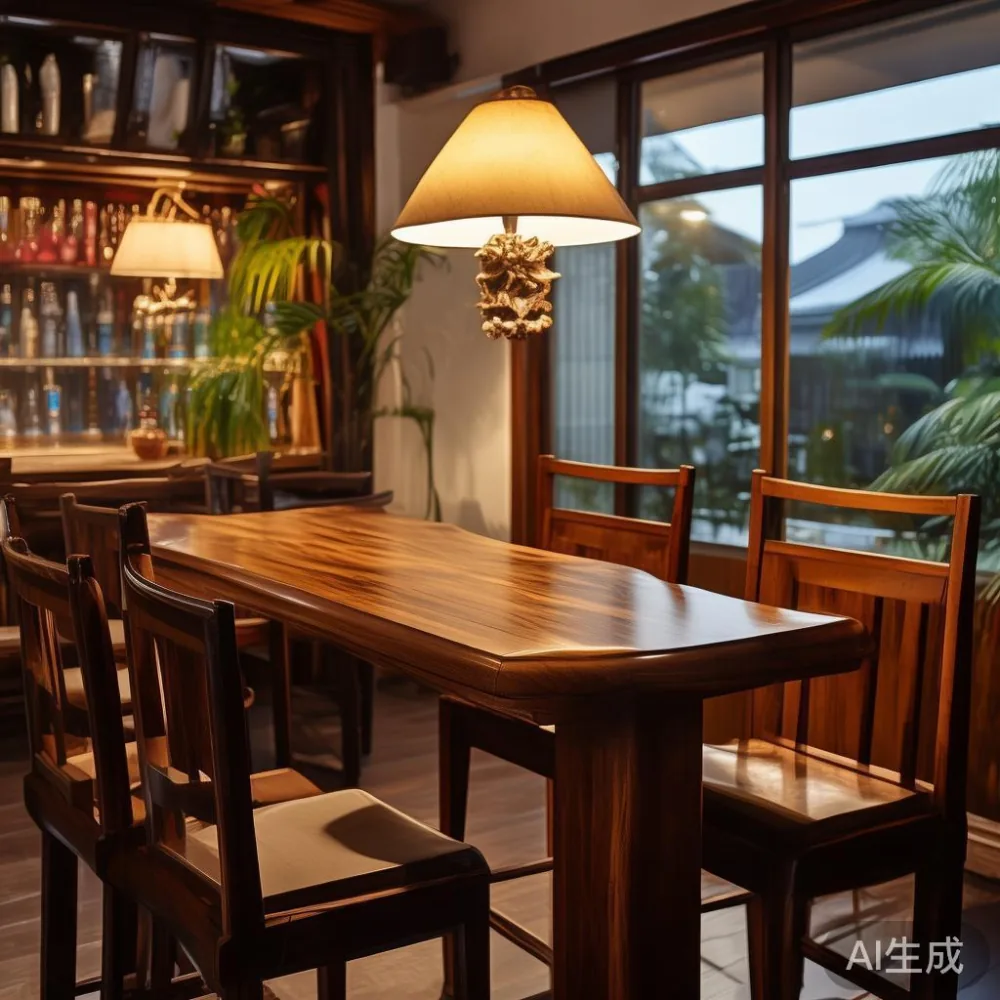
At MIDHILL, a Foshan workshop that has been shaping solid wood furniture since 2008 and now ships to more than fifteen countries, we talk about moisture the way other workshops talk about joinery. It is the silent partner in every glue-up, every panel glue, every drawer fit. The piece you put in your Bedok or Punggol living room was probably milled at 12% moisture content in Guangdong, and it needs to settle gently into your home rather than fight it. This guide walks through what is actually happening inside the wood, what you can see on the surface, and what small daily habits will keep a piece looking good for the next fifteen years.
Why does wood even move when the weather changes?
Wood is hygroscopic. That single word explains more about furniture complaints in Southeast Asia than any other. Cut a tree into a plank and the cells keep behaving like tiny straws, soaking up or giving off water vapour until they reach equilibrium with the surrounding air. The fibre saturation point — roughly 25–30% moisture content — is where the cell walls themselves start swelling and shrinking. Below that, every 4% swing in indoor relative humidity produces about 1% of dimensional change across the grain of a typical hardwood such as teak, white oak, or ash.
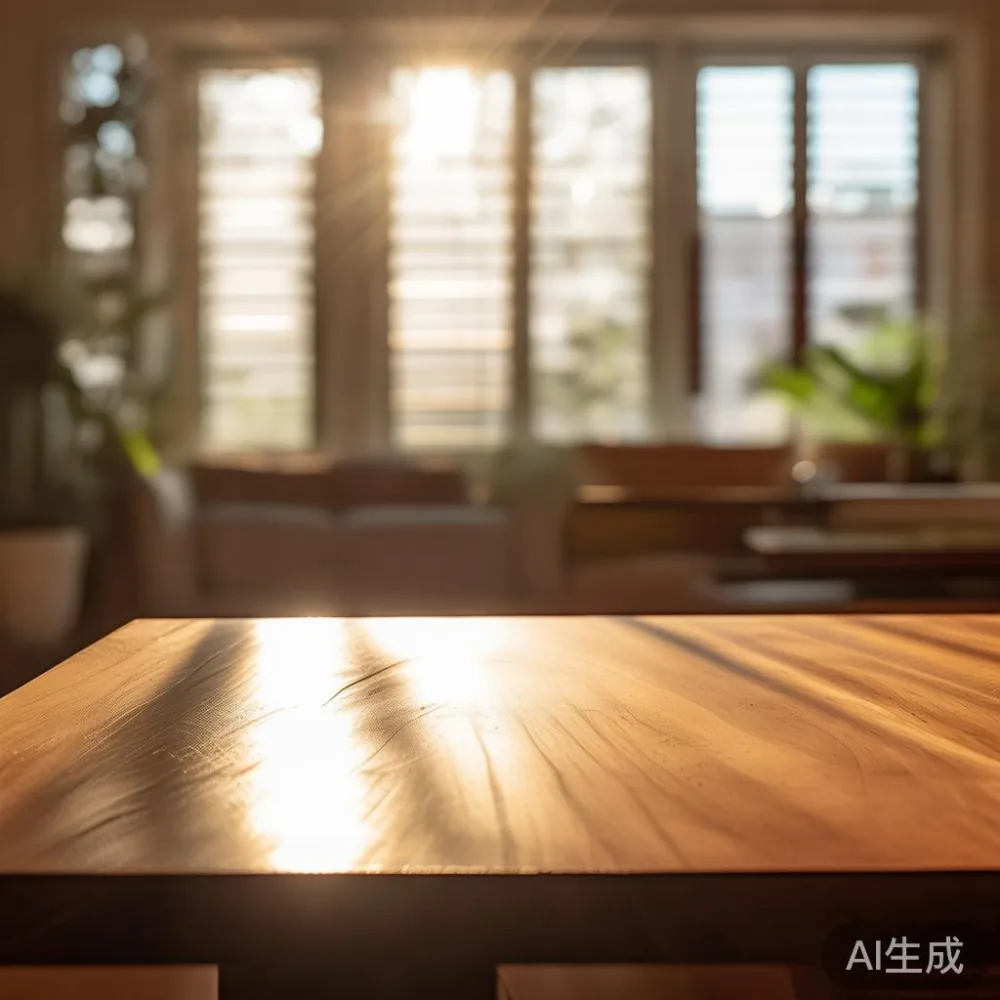
For an 80 cm wide solid wood table top, a 4% swing works out to roughly 8 mm of width change across a full year if the piece is left in an unventilated corner. On a 180 cm dining table or a 120 cm bar table that you actually use every day, the movement is visible at the seams and felt at the drawer slides. The wood does not fail; it simply negotiates with the climate.
What does Singapore humidity actually look like, by the numbers?
Outside, the daily mean relative humidity sits between 70% and 85% for nine months of the year and never drops below 60% even in February. Inside a typical HDB flat with the windows shut and one aircon running, I have measured 58% at 10 pm and 71% by 7 am. Open a balcony door for twenty minutes during a rain shower and the indoor reading can climb 12% in under an hour. If your bar table lives on a 4 m² service balcony off the kitchen — and many Punggol and Tampines layouts put exactly that — the piece can see 55% to 88% within a single afternoon.
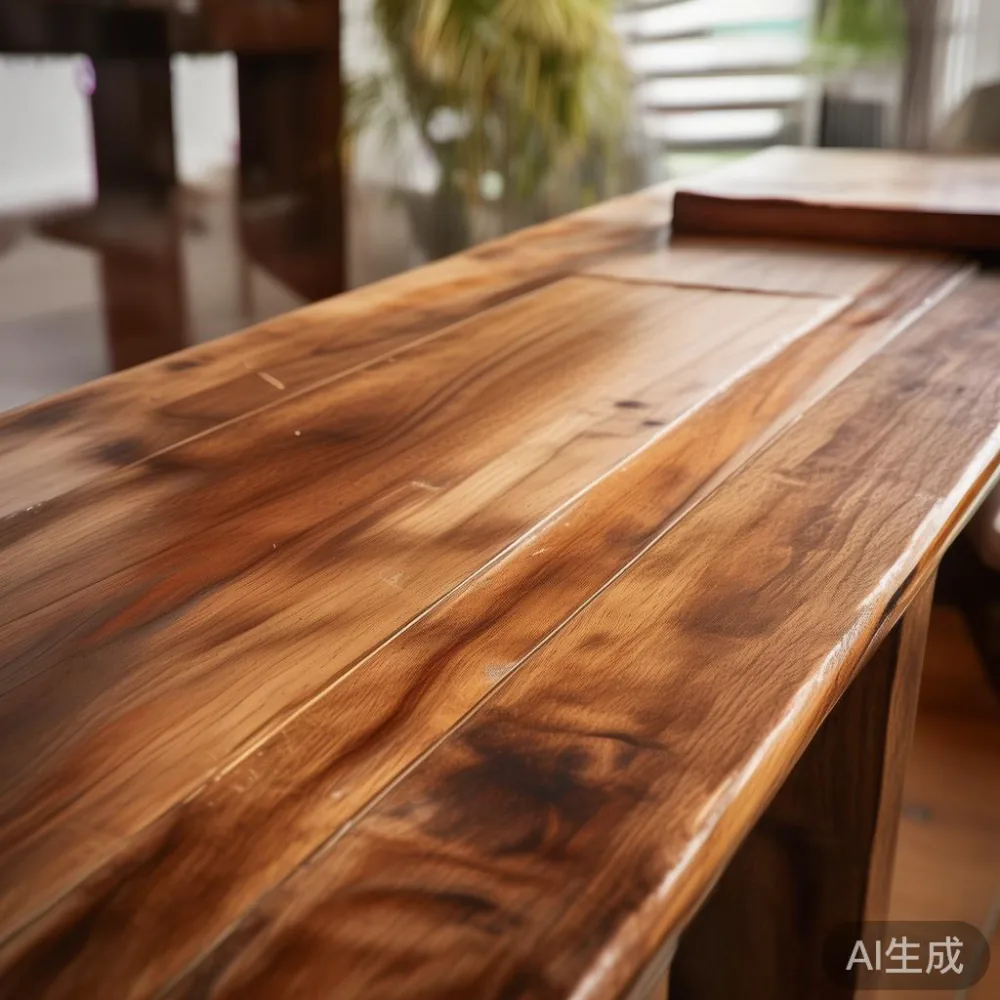
Those numbers explain the small daily routine I now follow. I keep the bar table at least 12 cm away from the sliding glass door so the cool glass does not chill one side of the top while the warm air hugs the other. I slide the aircon to dry mode for 45 minutes before I leave for work in the morning. The hygrometer on the wall costs about SGD 18 from any neighbourhood HomeFix, and the reading is the cheapest insurance policy a wood owner can buy.
What size balcony furniture do I need?
A bar table under 120 cm long and 60 cm deep will fit a 4 m² HDB service balcony with at least 70 cm of clearance on every side, and that clearance is the right number for humidity control because it lets air circulate past the legs and underside of the table.
Most service balconies in Singapore measure between 3.2 m² and 5.5 m² once you deduct the aircon compressor box and the clothes-drying rack. A bar table in the 100–115 cm range, paired with two stools that tuck fully underneath, leaves enough room to mop the floor, hang laundry, and still sit with a coffee on a Sunday morning without your elbow hitting the wall. Lift landings in older HDB blocks are roughly 1.2 m wide and 1.8 m deep, so anything bigger than a 120 cm flat-pack has to be ordered with the building's lift dimensions in mind — measure first, pay the deposit second.
How does humidity show up on a piece of furniture?
The first thing most owners notice is a faint cupping along the edge of a table top. Run your palm across the long edge in the morning and you can feel the wood is not perfectly flat anymore. Six months later, hairline cracks appear at the end-grain seams, and the drawer that used to glide shut now needs a firm push. None of this is a defect in the joinery — it is the wood telling you the room swung too far in one direction for too long.
On a solid wood sofa frame, the side rails can move a few millimetres and the cushions will sit unevenly for a day before the wood catches up. A wardrobe door can develop a slight warp that throws the gap wrong by 1–2 mm; a small brass tongue on the keep can be adjusted in five minutes. A nightstand drawer might swell enough that you have to sand 0.5 mm off the bottom corner. None of these are reasons to panic, but they are reasons to keep a hygrometer in the room and to act on what it tells you.
The finishes used in our Foshan workshop — a hardwax oil on the open-pore teak, a conversion varnish on the closed-grain ash, a penetrating oil on the walnut — all breathe. That matters in this climate. A thick plastic film finish will trap moisture under the surface and produce the cloudy haze that drives owners to assume the wood itself has gone wrong. The finish is a coat, not a coffin.
What habits keep a bar table stable in Singapore?
I run a short list on every piece of furniture I place in a Southeast Asian home. Position the bar table at least 10 cm from any exterior wall — the concrete behind it carries condensation for an hour after a thunderstorm. Avoid direct sun through a north-facing window between 11 am and 2 pm; ultraviolet plus heat dries the surface unevenly and produces the visible colour shift that makes owners think the wood has faded. Set the aircon to 24–26°C with the fan on low rather than the highest cool setting, because aggressive cooling creates a 4°C difference between the air under the table and the air two metres above it, and that gradient is what drives the cupping.
If your balcony is enclosed and you run a dehumidifier, set it to 55% rather than the 40% that most user manuals suggest. A 40% target in Singapore means the unit cycles constantly, your electricity bill climbs past SGD 30 a month for the room, and the wood is pushed so dry that it will crack when the door opens for thirty seconds. 55% is the sweet spot for a solid wood bed frame, dining table, wardrobe, nightstand, or bar table — low enough to discourage mould, high enough to keep the wood cells from collapsing.
Wipe the surface once a week with a barely damp microfibre cloth, then follow with a dry cloth. Never use a spray polish that contains silicone — it builds up a film that traps the very moisture you are trying to manage. A bottle of neutral pH wood soap costs about SGD 22 and will outlast four cans of aerosol polish.
Why does light luxury fit this climate so well?
French light luxury and American light luxury both share a quiet confidence in materials — a thin marble top on a slim brass base, a single accent chair in bouclé, a low teak cabinet with hairpin legs. None of that survives a damp climate if the bones are wrong. Post-modern light luxury, with its mix of stone and warm timber, is the style that travels best to a Tampines condo because the proportions are generous and the materials are honest.
A bar table with a Carrara marble top and a solid teak base, measuring 110 cm long by 55 cm deep, weighs roughly 38 kg and sits well within the lift access limits of any HDB block built after 2010. The marble is sealed at the workshop with a penetrating sealer that resists water marks for the first ten minutes after a spill — long enough to wipe, not long enough to leave. The teak base is glued with a marine-grade adhesive and finished with the same hardwax oil we use on our bed frames and wardrobes, so the maintenance routine is identical across the whole set. One bottle of soap, one microfibre cloth, one routine.
For a four-piece dining set in American light luxury styling — table 180 cm, six chairs, sideboard 160 cm — the total weight is closer to 95 kg and the shipping volume runs roughly 1.4 cubic metres. MIDHILL ships such sets from Foshan to Singapore in 35 to 45 days by sea, and any single order above US$350 ships free; once the goods clear Singapore customs, GST at 9% is added to the invoice, and our delivery partner handles the lift and the corridor turns. Most corridor widths in HDB blocks measure 1.2 m, which is exactly the clearance needed for a fully assembled dining table — but if the corridor is tighter, we will flat-pack the top at no extra charge and reassemble it in your home.
How does MIDHILL handle humidity at the source?
Every plank that enters our Foshan workshop spends fourteen days in a holding room held at 18% moisture content before any cutting begins. The CNC operators measure the moisture content of each board before the glue-up, and the kiln-dried teak we use for Nordic teak entryway furniture pieces — those slim console tables and shoe benches that ship so well to Singapore condos — is verified between 10% and 12% before it reaches the sanding room. We use the same kiln schedule for the boards that end up on a dining table, a bed frame, or a bar table top.
Every piece ships with a felt pad set, a 50 ml bottle of the matching hardwax oil, and a printed care card in English. The card lists three numbers: indoor humidity 45–60%, room temperature 22–26°C, and a wipe-down interval of seven days. We do not hand you a piece and disappear. The structural warranty on every frame runs ten years, and refinishing is offered for the lifetime of the piece at a flat SGD 180 per piece plus shipping — a price that has not moved since 2019. If a humid season leaves a hairline crack, we would rather fill it, sand it, and return the piece to you than sell you a new one.
What should a Singapore buyer check before placing an order?
Three small conversations protect you from 90% of the moisture-related problems we see. First, ask the maker for the moisture content reading of the boards at the time of glue-up. Any workshop that measures will tell you; any workshop that does not measure is guessing. Second, ask what finish is on the piece and whether it can be locally repaired. A wax or oil finish can be refreshed in your home with a cloth and twenty minutes; a conversion varnish has to go back to a spray booth. Third, ask about the warranty in writing, including the parts and labour terms, not just the marketing line.
Then measure your home. The width of the service door, the depth of the lift, the turning radius of the corridor at the corner. Take a photo of the route the box will follow on the way in. We have rescued three deliveries to Bedok this year alone by spotting a 1.1 m lift door on a customer’s photo before the piece left Foshan — the dining table was rebuilt as two 90 cm halves with a hidden bolt system, no extra charge, no delay.
What about returns and small repairs?
Singapore customers have the same 14-day return window we offer in every market. If the bar table arrives and the colour, proportion, or finish is not what you expected, we arrange the return pickup and refund the piece price once it lands back at the workshop. Shipping and the 9% GST are not refundable because the goods have already crossed the border; the piece itself is fully refundable. For small moisture-related issues that show up after week two — a slight cupping, a tight drawer, a hairline crack at a seam — those fall under the structural warranty and are handled by a technician visit, not a return.
The most common call we take in a Singapore monsoon week is a wardrobe door that has drifted 2 mm out of square. The fix is a 0.8 mm brass shim behind the hinge, a five-minute job, and we have three technicians based in Jurong who can be on site within 72 hours. The fix costs nothing under the warranty; the technician visit outside warranty is SGD 60, which covers the trip and the first hour of labour. The lifetime refinishing option means a ten-year-old dining table can be returned to the original colour in 2026 for the same SGD 180 it cost in 2019.
A bar table in a Singapore home is a small, daily object. It is where the laptop sits on a Sunday morning, where the children do homework, where two friends share a drink after a long week. The wood will move a little with every season and every afternoon thunderstorm. That is not a flaw in the piece; it is a property of the material. Give the wood a stable room, a steady wipe-down, and a maker that picks up the phone when something drifts, and the piece will outlast the aircon compressor three times over.